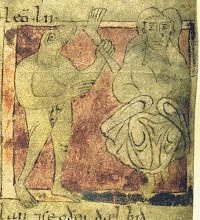
From the left, a Challenger. . .
Confessio docendis No. 3*
The classroom in which I teach is angled in such a way that I can approach it from the stairwell without being seen. Doing so today, I heard some students discussing the day's reading (the General Prologue of the Canterbury Tales, in middle English thanks to Norton's brilliance). Initially, they were in agreement that it was hard to read (no surprise—in a summer course, how much of a crash course can I give them?), and then they complained about my pedagogy. So when I finally rounded the corner, I said something flippant and defensive, and then one of them asked why we needed all this history in a literature course. Would it be on the test?
After the few seconds it took to recover from my internal weeping, I responded that I don't teach to the test (it's not No Child Left Behind, after all), and that while I do realize I don't talk about the text enough, I generally believe that they're smart enough to read the text without me having to explain it to them. Granted, with the Canterbury Tales and perhaps later with the Faerie Queene and Paradise Lost, there will be some moments where syntax or sense runs away from the text, and I'll have to slow down and point at stuff. But generally speaking, in a class full of Junior and Senior English majors, I would expect them to be capable of reading a text, especially one whose language has been modernized, understand the content, and form some opinion of its meaning. My job, then, is not to say "There is meaning in the text," but to say, "there is extra meaning around the text that you need to understand the text further."
For instance, yesterday I taught the second half of Sir Gawain and the Green Knight. On Wednesday I had left them with the thought that it might all be an allegory for the soul's journey from perdition to perfection—but then we get to day two, which is, as always, kinkier than I remember.** So, I thought, what better time to explain courtly love? Granted, I needed to take them back a bit and explain its origins, especially given that those origins are so contentious,*** but overall it went pretty well. Once I'd explained how it worked, I took them into the text and demonstrated how Gawain embodies those virtues and how the Pearl-poet challenges them. That, ideally, is the sort of thing I do every day.
So, I explained this to the student, who seemed to accept this as an explanation. Most of my fellow TAs who have heard this story have agreed with me: lectures are for context, not content. That said, I'm not against talking about content if the students are having trouble with it; however, what I want is connections made and understanding brought into focus.
I'm glad someone challenged me, though; most of the time I only hear such complaints after the fact in our evaluations. Getting it here allowed me to articulate it for the class as a whole, and probably staved off a few negative reviews while opening a few minds to the real goal of this course: getting them to think about why we produce literature and to what ends we do so.
Grade Statistics: Week Two:
A: 2 (13%)
B: 7 (44%)
C: 3 (19%)
D: 1 (6%)
F: 3 (19%)
16 enrolled students.
2 withdrawals.
Grade is based on 9 days of attendance. That's almost a curve, really, and it's doing what it ought: most students have been there most of the time, and only a few are really screwing off. We'll see how things are next week, after I get and grade their exams.
_____
* No. 1? The larch. Seriously, you expect me to keep track of this, as if it were some series, here to amuse you?
** Bercilak's wife pins Gawain to the bed and says he can't get up until she gets a kiss. If that's not wonderful, I don't know what is.
*** I did a combination of The Allegory of Love and The Arabic Role in Medieval Literary History.
Showing posts with label shining moments in pedagogy. Show all posts
Showing posts with label shining moments in pedagogy. Show all posts
20070713
20070328
De arte docendi
Or, "Reasons that I really love my job."
Here's the latest: like most of us with a two-class teaching schedule, I have one sheep class and one goat class. Not surprising, the goat class is the (insanely) earlier of the two, and while it does have its moments,* it's largely a dud. Enter the second class, whom I dishonor by calling sheep.
We're discussing a moment in the Tale of Genji today in which Genji demonstrates that he's grown (Chapter Four, for those of you following along at home). In the first class, I can't even get simple answers to questions like, "what happens next?" In the second, however, they sidetrack me into a discussion of aesthetic vs. intellectual knowledge, followed by an attempt to read Genji's actions as having roots in his childhood, which means I have to derail that branch of psychoanalytic criticism with the Bookerian "literary characters don't have minds" explanation. Neither discussion was expected, but both were rewarding, and I was pleased that when they didn't understand, they asked me to explain until they did (or until they got tired of me talking, but don't burst my bubble).
That's the kind of teaching I like. Give me juniors and seniors in the humanities every time!
_____
* One of my favorites occurred this past week. It's the first day back after Spring Break, and we're doing The Tale of Genji, and they're all huddled in the back. So, as you do, I walked in and said, "Neither Genji nor I will bite. Why are you huddled in the back?"
"We're afraid of you," said one.
"Good."
"We're afraid of your talons."
Mind you, these are college-age kids, and this guy's a good 20, 21 maybe. "What talons?" I say, looking at my hands.
"I've seen Wolverine. I know how it works."
Flash forward to Wednesday, when this person's sitting up front. "Ah," I say, "you've more courage today."
"No," he says, "I just have my sword and shield."
See? Precocious--but not educationally speaking.
Or, "Reasons that I really love my job."
Here's the latest: like most of us with a two-class teaching schedule, I have one sheep class and one goat class. Not surprising, the goat class is the (insanely) earlier of the two, and while it does have its moments,* it's largely a dud. Enter the second class, whom I dishonor by calling sheep.
We're discussing a moment in the Tale of Genji today in which Genji demonstrates that he's grown (Chapter Four, for those of you following along at home). In the first class, I can't even get simple answers to questions like, "what happens next?" In the second, however, they sidetrack me into a discussion of aesthetic vs. intellectual knowledge, followed by an attempt to read Genji's actions as having roots in his childhood, which means I have to derail that branch of psychoanalytic criticism with the Bookerian "literary characters don't have minds" explanation. Neither discussion was expected, but both were rewarding, and I was pleased that when they didn't understand, they asked me to explain until they did (or until they got tired of me talking, but don't burst my bubble).
That's the kind of teaching I like. Give me juniors and seniors in the humanities every time!
_____
* One of my favorites occurred this past week. It's the first day back after Spring Break, and we're doing The Tale of Genji, and they're all huddled in the back. So, as you do, I walked in and said, "Neither Genji nor I will bite. Why are you huddled in the back?"
"We're afraid of you," said one.
"Good."
"We're afraid of your talons."
Mind you, these are college-age kids, and this guy's a good 20, 21 maybe. "What talons?" I say, looking at my hands.
"I've seen Wolverine. I know how it works."
Flash forward to Wednesday, when this person's sitting up front. "Ah," I say, "you've more courage today."
"No," he says, "I just have my sword and shield."
See? Precocious--but not educationally speaking.
Labels:
academics,
confessions,
shining moments in pedagogy,
teaching
Subscribe to:
Posts (Atom)