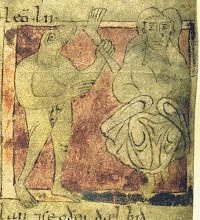
20070603

Summer Reading Reviews, Part 2:
La chanson de Roland

Note to the reader: This review is in three parts: the first is an exercise in writing an academic review (here to keep the punters happy), the second is a reaction to the text itself, and the third is a list of questions I’ve yet to fully ponder that arise from the text. If you’re interested in my reactions, skip to the part so labeled. -- Ed

Review

Brault, Gerard. La Chanson de Roland: Oxford Text and English Translation. Student Edition. University Park, PA: Penn State UP, 1984. Pp. xxxiii; 245. $15.00.

A student edition of a larger work is often necessary, since we expect our students to be less interested in the sorts of minutiae that we tedious academics get lost in. Yet a student edition must be helpful and useful to the students’ understanding of the text, and that goal is in Gerard Brault’s 1984 edition of the Chanson de Roland, occasionally lacking. On the one hand, the introduction seems largely useful, helping to distinguish all the cultural and genere forms that produced this text. He moves quickly through the kinds of narrative poetry that France produced in the High Middle Ages to the “Historical Event” of Charlemagne’s disastrous campaign into Andalusia in the late eighth century. From there he discusses the development of the legend, then of the chanson itself, before analyzing its usefulness as an historical document. All this is done in a clear and concise prose style that would seem to work quite well for the general undergraduate reader.

There are, however, flaws in this introduction, as well as in the edition itself. These are in some places stylistic issues and in others questionable choices about what and how certain information is presented. He cites, for instance, Schliemann excavating at Troy as a reason to give some credence to the poem’s historical relevance (xix); not only is this an old chestnut, but it is not a very meaty one at that (Schliemann’s methods were not the best, nor was his poly-chronic reconstruction of “Troy” the Homeric city). Too, he occasionally lapses into strange idiom, such as the puzzling notion that “as in contemporary society, individuals in this epic are also bound together by feudal ties involving mutual obligations between lord and vassal” (xx). Unless Brault has been living in an alternative France, one can only assume he means “contemporary to the poem,” or perhaps to AD 778, something that in any case is not clear from the context. While later usage seems to indicate the former meaning, such imprecision in the introduction does not bode well for the translation ahead.

Perhaps most annoying is the lack of an apparatus criticus and footnotes, both crucial features for understanding a poem no matter what one’s academic standing. Taken in conjunction with his abbreviated bibliography of works largely in French, and his quasi-literal translation of the poem, one is not certain for what sort of “students” Brault expects this volume to be useful. French majors are presented with a ready-made trot; literature majors are not presented with a very literary rendition of the text; and the majority of today’s undergraduates, lacking a guide to the meaning of the text, will see the poem as just another incomprehensible relic of the middle ages.

Reactions to the text

The ideological machine that this text contains is centered largely on the dehumanization of the Saracen. I use “Saracen” deliberately here, since it contains the European idealization of the Muslim other. (Note: I’m almost certain I’m not the first person to say this, and if I’ve not given credit for this idea it’s because I can’t remember where I’ve read it). The Saracen in this text is dehumanized in a number of ways, some subtle, some less than that.

An example of the more subtle dehumanization occurs in brief moments such as this: Oliver, Roland’s companion, [1] looks out over the field of battle and says:

Jo ai veüt les Sarrazins d’Espaigne,
Cuverz en sunt li val e les muntaignes
E li lariz e trestutes les plaignes.
Granz sunt les oz de cele gent estrange (laisse 84)

I have seen the Saracens from Spain; the valleys and mountains are covered with them, the hillsides, too, and all the plains. The armies of that foreign people are huge.

The Saracen other becomes a blight on the land, like a plague of locusts.

In another sense, they are a blight since they are comprised of things that are always “almost knights,” people who ben resemblet barun (look a good deal like a true knight, laisse 229). They follow the same martial culture as Charles and his men, but they cannot be true knights, quite likely because they employ monsters:

De Micenes as chefs gros:
Sur les eschines qu’il unt en mi les dos
Cil sunt seiet sensement cume porc (laisse 232)

Of large-headed men from Misnes: on their spines, along their backs, they have bristles like pigs.

This detail, coming at the start of a list of the different nations that make the Saracen army, throws suspicion on all the “normal” people who follow in the list, not only those ki uncles ben ne volt (never wished to do good, laisse 232) but monstrous races as well. This highlights something about monsters that I’d not considered before: the Monstrous Races are always objectified. At no time does anyone expect a man to live, work, worship, or fight alongside monsters, for there is always the chance that you yourself will become one by proximity. Furthermore, no monster ever speaks nor has it own agency; those that speak at all, e.g. the Donestre, do so in the voices of others.

I’m reminded, too, of an essay by Greta Austin, in which she points out that the line between nation and race is paper-thin in the middle ages, and the line between race and monster is equally porous. [2] One could easily collapse the categories depending on polemical need, and thus it seems almost anticlimactic to discover that some of the members of the Saracen army aren’t human; after all, to the medieval European eye, nothing from the Orient was ever really human.

The Saracen is also marked by conspicuous wealth. From the start, they may not have a good army, but they can bribe Charlemagne with:

curs e leons e chens
set cenz camelz e mil hosturs muërs
d’or e d’argent iiiiC muls cargez
cinquant carre qu’en sent carier (laisse 3)

bears, lions, dogs, seven hundred camels laden with gold and silver, and fifty carts for a wagon train.

Ironicallly, Blancandrin, the speaker and “one of the most cunning pagans” (de plus saives paiens, laisse 3) next says that with such a bribe, Charlemagne “will be able to pay his soldiers well” (ben en purrat luër ses soldeiers, laisse 3). One wonders why King Marsile of Saragossa hasn’t bought his own army with such a treasure-hoard, or indeed why he should in effect become paymaster of the Christian army. The obvious answer—because God wills it—is not enough. Rather, I think it has much to do with the idea that Muslims are Orientals and therefore rich and stupid. Something in me also suspects that this is a post-Crusades mentality; while the Andalusian Caliphate was rich, I think, to borrow Professor Tolkien’s famous phrasing, “the tale grew in the telling.” After the mentality arose that one could go East and seek one’s fortune along with penance, I suspect it became much more common to assume that the Oriental would be a source of wealth for the Occidental. However, this is mere assumption, and I haven’t a thing to back it up with yet.

There is, however, this: the Saracens in this poem are an often indirect source of European wealth. Consider Roland’s “oliphant,” the elephant-tusk horn he carries with him. There being precious few oliphants in Europe since the last Ice Age, how else might he have gotten it but from Saracen traders? It is a surprisingly Oriental signifier in the midst of all this anti-Oriental luxuria.

Indeed, the portrait of the Franks is at times as disturbing as that of the Saracens. Their motives are typically rather thin; Ganelon, for instance, displaces the impetus for conquest off of Charlemagne and onto Roland: it is Roland who because “he holds sway over the Emepeor himself / will conquer for [Charlemagne] all the lands from here to the Orient” (l’emperere meïsmes ad tut a sun talent / cunquerrat li les teres d’ice qu’en Orient, laisse 30). No other reason is given for conquest—the famous “pagans are wrong and Christians are right” must wait until the battle begins, some 600 lines from this point—and one is led to assume, as Blancandrin says here, that “Roland is a maniac” (mult est pesmes Rollant, laisse 30).

The Franks also have curious rituals surrounding death: The cultural anthropologist in me is more interested in the death ritual that Roland performs (laisse 174) including the choice of a pine tree, placing his valuable weapons beneath him, turning his face to the enemy, and—most curious of all—pur ses pecchez, we are told, Deu en puroffrid lo guant (he offered his gauntlet to God for his sins), as if he is pledging his service to God in the afterlife. It all seems quaintly Germanic: dying under a tree, showing no fear, soldiering for God when you’re dead. I’m reminded most of all that I need to pick up James Russell’s The Germanization of Early Medieval Christianity. To make matters stranger, after the Franks cut out Roland, Turpin, and Oliver’s hearts and set them in a casket while wrapping the bodies in stags’ skins (ritual!), the pagans arrive, and in a rather disturbing scene of re-arming, all the regions of the Carolingian empire are mentioned, as if this were a 12th-century rendition of Triumph of Will: each region is strong, proud, and unafraid of battle (laisses 218-225)

In the end, neither portrait really matters, since the end result of this conquest is rabid anti-Semitic fantasy, as “idols” are smashed in Saragossa:

A mil Franceis funt ben cercer la vile
Les signagoges e les mahumeries
A maliz de ser e a cuignes qu’il tindrent
Fruissent les ymagenes trestutes les ydles
N’i remendrat ne sorz ne falserie (laisse 266)

Orders are given for a thousand Frenchmen to search the city, the synagogues and the mosques; holding iron hammers and axes, they smash the statues and all the idols. No sorcery or false cult will remain there.

The point here being that of course this did not happen: Saragossa was steadfastly Muslim until well into El Cid’s day.

I’m leaving out a lot, I know—battle scenes, the quick and surprising conversion of Bramimonde—but these are some of the weird images I’ll take away from the text, along with a general idea that, although we are supposed to believe the Christians are right, neither side comes out very well in the telling.

Notes

[1] I have an idea that “companion” here might have something to do with Alan Bray’s notion of the “friend” (see The Friend), but swive me if I can see anywhere to run with this idea.

[2] Greta Austin "Marvelous Peoples or Marvelous Races? Race and the Anglo-Saxon Wonders of the East.” Timothy S. Jones and David A. Sprunger, eds. Marvels, Monsters, and Miracles: Studies in the Medieval and Early Modern Imaginations. Kalamazoo: U of Michigan Press, 2002. 25–51.

Questions
  • How demonized were the “Saracens” in heroic literature before the Crusades?
  • What else—besides the ambiguous wascones in the Carolingian chronicles—did the “universal enemy” of Saracen replace?
  • Is the choice of “Saracen” as enemy a deliberate (or “accidental”) internationalizing of the story from something only locals would know to something all who read it would understand as “other”?
  • Is Roland more of a hero fighting Saracens than if he were fighting “Wascones”?
  • How did later ages in France treat the Carolingians?
  • Is it even worth being surprised anymore that the luxurious and effeminate Saracens also use as soldiers monsters from farthest Ethiopia (laisse 143 ffl)?
  • What’s with the beard fetishism in medieval heroic texts? El Cid grows his out, Charles exposes his beard to show he’s unafraid (so does the pagan king)—what gives? Weird masculinity signifiers?

20070527

RIP Mary Douglas

I don't always catch this sort of news, but it's highly important today: Dame Mary Douglas has died.

She taught us how to think about boundaries, bodies and taboo as linked cultural objects, and her structural analysis of Leviticus—however much she repudiated it in her later years—was paramount in reshaping entire fields of study, especially the early medieval. May she rest well, hopefully with a very elaborate yet deliberate funereal ritual.

20070523

Summer Reading Reviews, Part 1:
Poem of the Cid

The Poem of the Cid: Dual Language Edition. Tr. Rita Hamilton and Janet Perry. New York: Penguin Classics, 1985. 256 pages.

This summer, I'm doing a readings course that is mostly about the literature of the Muslim-Christian contact in the Middle Ages. I'll read The Poem of the Cid, The Song of Roland,Wolfram von Eschenbach's Parzifal, Arab Historians of the Crusades, The Arabs and Medieval Europe, Europe and the Mystique of Islam, and The Orient in Chaucer and Medieval Romance. I'll probably also read The Arabic Role in Medieval Literary History, if I have time. My plan is to read them, then blog about them here, mostly because I haven't heard otherwise yet.

We start this week with the Penguin edition of the Cantar del mio Cid, which was probably composed in the 12th century, but exists in a single manuscript dated to the 14th century. Like any good scholarly edition for those of us whose linguistic training doesn't extend as far as it ought, it's nicely dual language so you can fake your quotes later (owning copies of the Loeb library classical editions is also paramount). The translation is quite readable, and kept parallel with the text so that by triangulating between the English, my Latin, and the Castilian, I can make out what the Castilian is saying.

That said, this is my first time reading the Cantar (or Poema; no-one's really clear about the preferred term, and it may just be the idiosyncrasy of the manuscript compiler) and let me tell you, it's weird. To be honest, it first put me in the mood for the next Pirates of the Caribbean movie, in that el Cid, having been exiled, decides to randomly besiege the neighboring taifa until he has enough money and prestiege to buy his way back into the king's heart. It's insane, and poorly justified, and has a nice bit of the usual medieval antisemitism in the front, in which Ruy Diaz fills two chests full of sand, pretends they're full of gold, and gets the Jews to loan him 400 marks (about £270 sterling, assuming a mark was about 13/6
a nice little sum).

What else? It's a national epic, they say, and that's not surprising; it's pure Castilian, in that—to borrow the refrain from La chanson de Roland—the pagans are wrong and the Christians are right. There are a few of the virtuous heathen, but they're in the minority; most of the Moors are awash in luxury, so much so that only a few years and battles later, Ruy Diaz has his entire fortune back twice over, and has a retinue that could seriously threaten the King of Castile. Good thing he's distracted from all that by the marriage of his daughters to the Infantes of Carrion, who turn out to be jackasses.

I'm sure all the Moors were relieved.

20070510

Doctor Why,
or the hazards of being an academic with nothing to analyze

Recently a friend goaded me into watching Doctor Who. Since I was deprived of the british childhood I so clearly deserved, I haven't seen it since it came on PBS in the eighties, and I half-remember it as mildly entertaining. However, rather than start with the First Doctor (William Hartnell) and move forward, I started with the BBC's 2005 renovation of the franchise, with the Ninth Doctor (the incredible Christopher Eccleston).

This was, as that incarnation of The Doctor might say, a "fantastic" idea. The new series is clever and well-written, and has cracking special effects that make a pile of living plastic believable, for starters. I watched them all—the Slytheen episodes, the Chula medship that turns everyone into gas-mask zombies, the Daleks (and then more Daleks!)—and loved them. However, since Netflix has decided to postpone releasing Series 2 (perhaps they think Scotsmen are less engaging than Northerners), I had a brand-new obsession and nothing to fill it with. So, naturally, given a show with a forty-three year history, I ordered more episodes from Netflix, this time starting at the beginning.

Bad move.

First of all, like a good number of things at the BBC, the old series was filmed in video, giving it that "soap opera actors have invaded London in pepperpots" feel. As such, I personally have a hard time accepting this as fiction; I had the same trouble with Red Dwarf a few years ago. [1] Hurrah, then, that the BBC seem largely to have given up that feel with the advent of digital technology.

Second, and perhaps more importantly, is the fact that these shows are awful. Now, before I get screaming letters,[2] let me say that the ideas aren't generally bad. What's bad, though, is the writing; George Lucas could out-write some of these people on a bad day with a hangover. Remember Science Fiction in the Sixties? Remember why MST3K made a decade's worth of episodes out of Science Fiction from the Sixties? That's the old Doctor Who, right up to Peter Davison (Fifth Doctor) [the sixth and seventh were kind of awful for other reasons, most of them having to do with the Eighties].

In his book Strange TV, M. Keith Booker writes that SF television had a rough patch between the mid 1970's and the late 1980's; he argues that Roddenberry's decision to relaunch Star Trek as a television program was the jumping-off point for nearly 15 years' worth of sold SF television. Since I don't have the book in front of me,[3] I'm paraphrasing, and I don't recall whether he also said this: what separates these modern shows from the old SF—the stuff we now see as "camp"—is the writing. Not the effects, though those have gotten better; not the ideas, since those were always good. It's the writing that makes the difference.

Television is now in its fourth generation, and, despite the challenges this nebulous "digital age" presents, it will likely remain with us for a while yet. As such, it's grown as a storytelling medium. Now, with shows like The Sopranos or The Venture Brothers or Rome, we expect top-notch stories that make us care about the characters; in short, we expect television to give us the same quality of story that we get from film, or novels, or drama. The fact that the new series of Doctor Who delivers on a level that the old series did not is a sign that the medium has begun to mature—and that's a good thing, because if humanity needs anything else, it's another quality medium in which to tell stories.

Of course, all this may change with the next series. Hurry up, Netflix, you bastards! [4]
_____
Notes:
[1] Other shows filmed in this way:
Are You Being Served?, 'Allo, 'Allo!, Mr Bean, Blackadder. I have problems with the former two because they're inane drivel, but for some reason it works for things with Rowan Atkinson in.
[2] Please post your howlers to . . . (Eee! Book Seven comes out in July! And it'll suck! eee!)
[3] But you should. By the blood that Mahund bled, it's a good book. His prose is
clear—a rare thing in academic books—and he's funny, too. Amazon; Half; WorldCat
[4] Things I am also waiting on from Netflix: the first series of
A Bit of Fry and Laurie, the second series of Rome, the third series of House, and, ironically, The Revolution Will Not Be Televised.

I suspect the compulsory lists are because I've been reading
High Fidelity again. It's nice to have books that make me think but don't automatically shift me into analytical mode.

20070507

Things I Did Today

In no particular order:

1) Discovered Manchild, the BBC's answer to Sex and the City, but with men. Equally self-absorbed, though deadly funny and British. It's like an older version of what the movie version of High Fidelity ought to have been (i.e. set in London, possibly with Nigel Havers doing the voice-overs).

2) Finished a draft of my House-of-Fame-is-utopian paper, then read two paragraphs in and realized that a definition of "utopian" would probably help.

2a) Made one.

3) Collected the last of my students' final exams, and, barring a few stragglers, will have grades up by Tuesday (for the first section) and Wednesday (for the second).

4) Started going through all the Libri legendi notecards I've made over the course of the semester (how did I get up to five this time?). If you don't keep lists of things you'd like to read, you're clearly not an academic. I think I'll be adding 50 or so volumes to the already 38-volume list.

5) Eyed the rest of Alan Bray's The Friend that I was thinking of finishing; watched Manchild instead (see #1).

. . . and that is all. Soon enough I'll be done and can relax properly.

20070426

How you know you've arrived, Pt 1.

You know you're in the business when you start getting rejection letters. Mind you, this isn't rejection from the big boys--Speculum, say, or the JMEMS--but from a small conference proceedings journal. I'm not mad, really, because their comments were right: that essay was really space cadet, mostly because it'd been cut down from my thesis and I'd not made the argument clearer in the revisions. In all fairness I thought the deadline was later (that's what I get for not going to the business meeting) and thus went at it in a bit of a rush.

Still, rejection's annoying, and part of me suspects I'll never amount to anything, but we carry on regardless, eh?

20070423

At the expense of taste alone

And now, taken out of context, here's a little levity. First, from Buckaroo Banzai Across the Eighth Dimension, here's the villain's big speech:


Meanwhile, here's one of the best lists ever, this from Blazing Saddles:

That's it for now.

Update: Apparently it wasn't. In honor of the recent death of Jean Baudrillard, I present startling old evidence that Peter Sellers didn't exist, either:

I'm almost done grading!

20070422

Recoveries and Updates

. . . and what a week it was. First, some personal news: I will teach this summer, and I get to teach World Lit. Compressing sixteen weeks of half-assed lectures into six weeks of kick-ass lectures ought to be good. I hope this works. Current plans include just a research paper, abstract at two weeks, progress form at four weeks, conferences M/T/W of the last week, a midterm exam at three weeks and an essay exam at the end. I was going to sit in on Bill's Chaucer course in the summer (and I might just to harass my Spenserian friend C-- P--), but that's still up in the air.

Yesterday was tough but fair; I spent the morning getting mad at the spotty wireless connection in my office, which had just enough connection to work but not enough to stream a Doctor Who video from Netflix (which I just noticed I was allowed to do now), which ate up most of the morning. You see why I don't get work done?

Ah, I say to you, but I did: the reading journals for Bob Brinkmeyer's class are done. I understand why we do these reading journals: like the 2000-word "reviews" we did for Lynda's Gender and Sexuality 600-1100 CE course a few years ago, short reviews are practice for when we actually do get to pick apart the books in our field. I am looking forward to writing reviews when I get the chance, and I also enjoy reading them, especially the at times quite vicious ones in Speculum . I just don't like doing them for short works of criticism in which I am only marginally interested.

Did I get any work done on my papers? No.

Did I grade any more of my students' papers? No.

Am I ready to teach Montaigne's "On the Imagination" on Monday? No.

That's when the potentially useful becomes frustrating busywork.

. . .

Finally, my thoughts are with the people of Virginia Tech as they recover from the loss of so many, including the brave and the clearly brilliant. We will mourn them as we here have mourned the loss of John Locke -- privately, and quietly, and with sympathy. As usual, my response to this tragedy is mostly directed at the media (even NPR is bad about this), who have taken this opportunity to do everything but be useful. Meanwhile, Ted Rall has it right. But that's another story.

20070414

Tiny Little Post

So, over at ITM, Karl made mention of the romance Sir Amadace (introduction here), which apparently has a lot of corpses, and I'm reminded of three things: I took to this job for the weirdness; I stayed in this job for the socially oppositional space it allows me to work from; marginal medieval romances are freaking weird and I will love them forever.

Unfortunately, today has to be spent on a Eudora Welty/Utopianism project, with a little Faulkner reading (as well as a bit of grading) mixed in. Non possest omnes facere, sed tempteamus, to misquote Edward Abbey in Latin.

20070410

I've been noticed!

So, I read In the Middle on a daily basis, because it deals with things I like: medieval studies, gender studies, and really strange monsters. Today, however, it deals with... er... me! So now I'm popular and famous and will get to, if not hold up the subjects of my poetry in court, at least mill around in Fame's courtyard, right? It's not like I'm out back with the rumor mill.

Guys? Hello?

*sigh* Back to work, then. Why is this wicker house spinning so quickly?

20070404

Hallelujah, I'm a Bum?

This article by the former director of the Salt Lake City Public Library points out that libraries are frequently on the front lines of caring for the homeless mentally ill.

Cheesy as it is, I'm reminded of a very heavy-handed pair of early episodes of Star Trek: Deep Space Nine, in which Sisko, Dax, and Bashir are sent back to early 21st-century San Francisco. Sisko and Bashir are arrested for sleeping in the streets and sent to live in the city's homeless ghetto, which is locked at night and is far worse than even the original ghetto. Yet despite the sheer isolation and dehumanization everyone faces there, the place depicted in that episode is somehow better than the solution we have now: if you fail in the system, you're out. Sleep on the streets, eat from the trash, and when it's cold, try to make the best of it in the library.

There are some people for whom this is a temporary situation, and others for whom this is a deliberate choice. Even since the earliest days of transience, though, there has been a system for describing the differences between these groups: as Ben Wrightman used to say, "A hobo works and wanders, a tramp dreams and wanders, a bum drinks and wanders." We know what to do with hobos (give them a good job); we know what to do with tramps (let them be tramps). What we do with bums--who drink, who do drugs, who doing neither still murmur down the corridors of their minds--is unfortunately what we do with tramps: let them be bums. And again, Chip Ward is right: we have to do something better. In the words of that old traveling nation poem:

Make the intelligent, organized choice
Get rid of the weights that crush
Don't worry about the bum on the rods
Get rid of the bum on the plush.

Only by taking money out of the hands of the apathetic rich, and putting it not into churches that do nothing or ponzi schemes that do little, put it where it belongs: in shelters full of well-trained people whose sole goal in life is to live in a world where they, and not their clients, don't have jobs any more.

20070401

Prepwork

Tomorrow I teach the Morte Darthur. Not the whole thing of course—this is a World Lit course, not one in the History of Literature in English or the English Romance or frankly anything else I'd like to teach but can't thanks to the fact this department runs on "tradition" rather than "job training"—but the "Tale of Lancelot." And I've already decided to write the quiz, because it would be easier to have it done early than to wait until the last minute and have to fight people for the copier. (As you can tell by that last sentence, Caxton's prose has struck again...). Deciding it needed a suitable Caxtonian preface, I went searching for a copy of Caxton's Malory... and discovered that the majority of people have only scanned the modern-spelling editions. Now, I've posted about this kind of intellectual laziness before,* and it's one reason among many that I've tried to OCR the Latin text of Newton's Principia, and have succeeded in putting up a copy of Peter the Nibbler's Historia Scholastica and Boethius' Arithmetica and almost succeeded in putting up his Musica.

I'm looking forward to it, mostly to see what they pick up on. This will be the first time that I've been able to give in-depth coverage to something over which I've written, and in some sense this will be a kind of revision process, except in the class where they look at me blankly. I'm using the big Everyman paperback I convinced Grant to buy, because it has modernized spelling but not grammar. It shouldn't be too bad for them, I think, but then I thought Genji would go well, too.

__________
* Or I thought I had. Surely somewhere there's a post in which I rant about... or was it an email? Oh, damn.

20070328

De arte docendi

Or, "Reasons that I really love my job."

Here's the latest: like most of us with a two-class teaching schedule, I have one sheep class and one goat class. Not surprising, the goat class is the (insanely) earlier of the two, and while it does have its moments,* it's largely a dud. Enter the second class, whom I dishonor by calling sheep.

We're discussing a moment in the Tale of Genji today in which Genji demonstrates that he's grown (Chapter Four, for those of you following along at home). In the first class, I can't even get simple answers to questions like, "what happens next?" In the second, however, they sidetrack me into a discussion of aesthetic vs. intellectual knowledge, followed by an attempt to read Genji's actions as having roots in his childhood, which means I have to derail that branch of psychoanalytic criticism with the Bookerian "literary characters don't have minds" explanation. Neither discussion was expected, but both were rewarding, and I was pleased that when they didn't understand, they asked me to explain until they did (or until they got tired of me talking, but don't burst my bubble).

That's the kind of teaching I like. Give me juniors and seniors in the humanities every time!
_____
* One of my favorites occurred this past week. It's the first day back after Spring Break, and we're doing The Tale of Genji, and they're all huddled in the back. So, as you do, I walked in and said, "Neither Genji nor I will bite. Why are you huddled in the back?"
"We're afraid of you," said one.
"Good."
"We're afraid of your talons."
Mind you, these are college-age kids, and this guy's a good 20, 21 maybe. "What talons?" I say, looking at my hands.
"I've seen Wolverine. I know how it works."
Flash forward to Wednesday, when this person's sitting up front. "Ah," I say, "you've more courage today."
"No," he says, "I just have my sword and shield."
See? Precocious--but not educationally speaking.
Neman telleth me ony thynge!

Chaucer has a blog, which he shares with his sonne Lowys and that trewest of lyars, Sir John Mandeville. The best parts: "Take that, Gower!" in the headline, and Mandeville's travel tips.

20070327

Envy by proxy

Thanks to a colleague, I've discovered that this sort of business is going on. Now, I'm all for decentralizing Western Europe's hegemony on interpreting the past, but the problem is that it's being done at Berkeley. California, this is the second project of yours I've read about to cause me much consternation and envious gnashing of teeth (the first being the 3d Plan of St. Gaul, which they clearly came up with only months before I did and which we wouldn't be able to do here until the fall at least, that being when the CAST opens). You're on notice for being so damned clever.

20070326

Outcome: The Resulting

I'm still alive. The Genji lecture went okay, the leading discussion thingy wasn't too painful, and I did see His Lordship and discuss the fall seminar and a possible future readings in Medieval Arthuriana. Not much else got done today, though when I got home Our Man Flint had arrived. Ah, James Coburn, will your spy never stop rising?
Why I shouldn't post before reading

So roscivs has a salient post about the problem of not enough mathematics in programming, to which I've added the following:

As odd as it might be to hear this, it's nice to see that English isn't the only department with these sorts of problems, and that the whole university system is feeling the "be useful and make things we can sell" push.

The problem is similar: in the department, we have people who study literature (and are thus armed with a lot of abstruse cultural and literary theory) and the people who create literature (and are thus armed with, er, so far as I can tell, pens). In addition, there's a major trend toward separation, putting the writers in one section and the theorists into a melange of "cultural studies." While I support interdisciplinary education—indeed, one of the best courses I took was team-taught by scientists, cultural theorists, historians and literary critics—the point was cross-pollination; the departments remained discreet, and what you were studying was added to by the intercession of these new voices. Making "interdisciplinary" the norm will set up new boundaries, similar to those you described between mathematics and programmers, that are no better than the "isolated department" scheme of the 1950's.


And I mean it. Taking a post somewhere as the "(Late) Medieval Cultural Studies" professor isn't going to be helpful to me or my students: I'm teaching history, social theory, archeology, and half a dozen other things I wasn't prepared to teach and really can't. The point is that there should be boundaries, across which you occasional sally, make a lecture or five, and come home. Tea with the historians, maybe an afternoon over in psychology, but you should always have your own department to come home to.

That said, of course, I'm in no position to complain, and a very large position to beg. If you're a prospective hiring university and found this blog, I love you very much and will teach however you want; I'm perfectly willing to try anything for five years and two books, and won't complain until tenure. Please?
What Got Done

Everything but the notes for Genji. Yes, even the dishes, and even the surprise "Oh yeah, the laundry I didn't fold today" pile.

Working on the lecture notes now, though it's early in the morning and I really need drugs.

20070325

The Real Wish List

All my life I've wanted a pet evangelist.

No, not really. Silly me. What I meant was, ever since I saw it, I fell in love. Saw what, you ask? Well, I can't show you for copyright reasons, but it's the best lion-headed evangelist you'll ever meet.

All right, it's this:

Hereford Cathedral Library MS O.1.viii, fol 46. This image (c) the Dean and Chapter of Hereford Cathedral. Unauthorized copying of the copy I made will result in a thrashing.

Look at that grin! He's the most naughty little lion-headed saint! You couldn't possibly resist it. Ever since I saw it in Carol Strickland's Saracens, Demons, and Jews: Making Monsters in Medieval Art, I knew it had to be mine--but it has to be in color.

Some years ago, my friend Brooke and I were at Cambridge, and she was touring one of their libraries and came across a ninth-century Irish Jesus. Immediately she shouted, "That's my next tattoo!" to which the curator responded, "No-one's ever said that before." But she got it, and it's damned awesome, and I want a medieval manuscript illumination tattoo as well.

So I find now that Hereford Cathedral is online, and they do let you have prints. But I can't quite bring myself to find if they're going to let me have this--and certainly not for a tattoo, of all things.

However, if you out there in Blogospheria can find a way, you will be rewarded handsomely. Possibly with a handsome cab.
Work Avoidence Schedule
So here I am, less than 24 hours to a presentation on Eudora Welty's The Golden Apples, and what do I do but "rediscover" Blogger. As it turns out, I've been reading several people's blogs, and decided that it was high time to become self-absorbed again. Besides, it's the hot thing to do--notice that of those four linked, two are professors, one is my adviser, one is an author, and one is a long-lost friend who seems to find mathematics and linguistics fascinating to the point of pathology. Also, there were two fathers and two sons--wait, wrong riddle.

(I also have to come up with a lecture on the Tale of Genji, bathe, do the dishes, and get my life in order. Any takers on what gets done first?)

SO:
I'm going to restart this here journal, is what I'm going to do. And I'm going to do it to avoid masturbating make a record of my scholarship and possibly life. My models are JJC's blog (up there), this one, and this one. Wish me luck.